

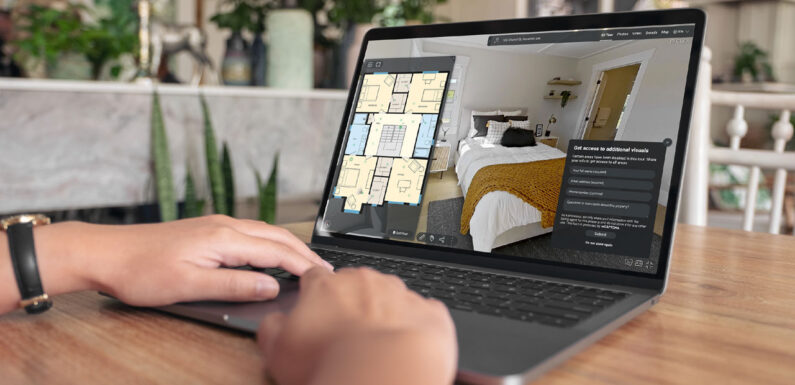
Most buyers search for properties online before they ever visit one in person. Real estate virtual tour services give them a way to walk through homes, offices, and commercial spaces from any device. This goes far beyond still photos. Buyers check room layouts, ceiling heights, and window views at their own pace.
The demand for these services keeps growing every year. According to PhotoUp, 54% of buyers skip listings that lack a virtual tour. Also, listings with 3D tours get 49% more views than those without, according to Precision Reports. So, the gap between agents who offer tours and those who do not keeps getting wider.
Therefore, whether you sell residential homes or large commercial properties, offering 360° Virtual Property Tours is now a basic expectation. This blog covers the benefits, tools, process, and the top ten companies delivering these services today.
What Real Estate Virtual Tour Services Actually Are
Real estate virtual tour services create an interactive, online version of a property. A buyer can click through rooms, zoom in on details, and explore the full layout without leaving home. These tours use 360-degree cameras or 3D scanning tools to capture every angle of a space clearly.
This is not the same as a video walkthrough. A real estate 360 virtual tour puts the buyer in full control. They choose where to look, which room to enter, and how long to stay in each area. This feels much closer to a real visit.
Also, a 360 real estate company handles the shoot, editing, and hosting of the final tour. The agent or developer then embeds it into a listing or shares it as a direct link. Buyers anywhere in the world can access it at any time. No scheduling or travel needed.
How the Process Works Step by Step
Developing a real estate 360 virtual tour technology entails several distinct processes. Understanding these steps will also help you evaluate what a good 360 real estate company should deliver.
The first step involves visiting the property where a 360-degree camera will take pictures of the entire building. This is the most time-consuming step because a normal house shoot requires two to four hours of photography.
Secondly, all the images will be uploaded and edited on a virtual tour platform. The images will be connected, and hotspots and floor plan details will be added in an additional one to two hours of work.
Finally, the virtual tour will be published through a link and then embedded in the listing or web pages and other social media platforms. Furthermore, the virtual tour is accessible using desktop computers, mobile phones, and VR goggles. Therefore, anyone can view it at any point in time from any platform.
Why 360° Virtual Property Tours Convert More Buyers
Old property listings relied on photos and short text descriptions. But photos do not tell the full story. According to PhotoUp, 75% of buyers say virtual tours heavily influence their purchase decisions. Moreover, homes with 360° Virtual Property Tours sell for up to 9% more and close up to 31% faster than those without. According to LLCBuddy, this gives sellers a direct edge and helps agents move listings more quickly.
Moreover, virtual tours remove geographical boundaries. Buyers from other countries are able to tour properties in other countries at their convenience, revisiting and taking notes before meeting the realtor. This saves everybody’s time. Additionally, virtual tours ensure more trustworthiness of the buyer and seller. Since the buyer will have seen every inch of the property, there are bound to be no surprises when they actually visit the property.
What to Look for in a Real Estate Virtual Tour Provider
Not every virtual tour provider delivers the same results. However, knowing what to check saves time and money from the start.
First, look at image quality. A good provider shoots at high resolution and covers every room without gaps or dark corners.
Second, check platform compatibility. The tour must work smoothly on desktop, mobile, and VR headsets.
Third, ask about MLS and website integration. A tour that does not embed cleanly into your listing platform loses its value fast. Fourth, check turnaround time. Most professional shoots should deliver a live tour within 24 to 48 hours.
Also, check whether the vendor offers cloud-based hosting. The software vendor may charge an extra fee if the tours exceed the specified limit. Therefore, it is important to ensure that this is included in the budgeting process. Also, choose a 360 real estate company with proven experience in property sales specifically.
Top Companies Providing Real Estate Virtual Tour Services
Below are some of the top companies known for strong real estate virtual tour services in 2025.
- Abhiwan Technology
It does not hand you a platform and walk away. They build the whole thing for you. Using Unity and Unreal Engine, their team works directly with property developers, enterprises, and real estate brands to deliver custom VR tour experiences from the ground up. India-based, but their client work spans globally.
- Trezi
They focus almost entirely on real estate, which is rare. Developers use them for both pre-launch campaigns and ready-to-move projects. Their AR and VR walkthroughs are built to work inside actual sales presentations, not just as add-ons.
- NS Ventures
They have been working in this field for the past eight years and have done more than 3,000 tours so far. Projects carried out by the company include those in India, the Middle East, and Europe. With respect to experience and the number of projects undertaken, NS Ventures emerges as a good choice to consider.
- 360Pano
360Pano is Delhi/NCR-based and covers a wide range of 360° walkthroughs, 3D rendering, VR showrooms, and floor plan visualisation. They have worked with both government bodies and private developers, which says something about their range.
- SunTec India
SunTec India has 25+ years behind it. That is longer than most companies on this list have existed. They cover residential, commercial, and hospitality properties and handle the full process in-house from photography to final 3D production.
What software is used for virtual tours?
Building a professional real estate 360 virtual tour requires more than a camera. Development teams use a range of software at different stages, from 3D modeling to final rendering and VR deployment.
| Software | Used For | Core Feature |
| Unreal Engine | High-quality VR environments | Photorealistic rendering, real-time lighting |
| Unity | Interactive VR and AR tours | Cross-platform build, fast deployment |
| AutoCAD | 2D floor plans and technical drawings | Precise architectural drafting |
| Revit (BIM) | 3D building and interior modeling | Full building information modeling |
| 3ds Max | 3D interior and exterior modeling | Advanced mesh and texture control |
| Blender | 3D modeling and scene rendering | Free, open-source, highly flexible |
Unreal Engine and Unity sit at the top for immersive VR tour development. Both handle real-time rendering, meaning buyers see lighting, shadows, and materials exactly as they would in a real space. So, high-end property developers prefer these for luxury listings and off-plan projects.
AutoCAD and Revit handle the design and planning stage. As a result, architects use these to build accurate floor plans before any 3D rendering begins. Also, Blender and 3ds Max are widely used for modeling interiors and furniture. Moreover, Adobe Substance Painter adds realistic textures to surfaces like wood, stone, and glass inside the virtual space.
What are the 5 types of real estate?
Real estate covers more than just homes. So, knowing the five main types helps agents and buyers understand where virtual tours add the most value.
- Residential real estate
Residential real estate houses, flats, apartments, and condos are where most buyers start their search. In fact, it is the largest segment by volume. A virtual tour here saves a buyer from driving across the city just to rule out a property in five minutes.
- Commercial real estate
Commercial real estate is a different game. These include offices, shopping centers, and restaurants. In most cases, the purchaser will be an investor rather than a house hunter, and they need to see what the property looks like inside before investing. This can all be done through the 360° Virtual Property Tours.
- Industrial real estate
Industrial real estate warehouses, factories, and logistics hubs have grown fast because of e-commerce. The people buying or leasing these spaces care about loading docks, ceiling height, and floor capacity. Virtual tours let them check all of that remotely.
- Raw land
Raw land has no rooms to walk through. But drone-based 360° shots still give buyers a strong sense of the plot size, terrain, and surrounding area. That matters a lot for developers planning layouts from scratch.
- Special-use real estate
Special-use real estate refers to properties built for a single purpose, such as schools, hospitals, hotels, and places of worship. A hotel developer, for instance, can walk potential investors through a 3D model of a room that has not even been built yet. That kind of preview speeds up funding decisions significantly.
Conclusion
Real estate virtual tour services have moved well past the optional stage. Clearly, buyers expect them. Agents who skip them lose listings to those who do not. According to Precision Reports, 67% of property listings now include some form of virtual tour, and that number keeps rising.
For the buyers, tours will allow for quicker decisions and decrease the chances of problems occurring when they visit. In the case of realtors, the tour results in a higher percentage of potential customers and a shorter sales cycle. For the developer, touring allows them to communicate with international investors without incurring any extra travel costs. The best way to do all of these things does not require spending a lot of money, either. After all, all one needs is a quality 360-degree camera, proper software, and a competent team.
Let buyers feel at home before they ever arrive. That is what strong real estate virtual tour services deliver, and why more agents depend on them every year.
