


A buyer searching for a part is not browsing. They are trying to match an exact specification to a machine, a vehicle, or a production line that cannot wait. This is why eBay for industrial and automotive parts sellers has remained a dominant channel even as newer marketplaces compete for seller attention.
Fitment tools built for vehicles, a dedicated Business & Industrial supply structure, and search behavior geared toward specification-led buying all solve problems that general ecommerce platforms do not address. For sellers deciding where to list high-SKU, high-specificity inventory, understanding why eBay is good for parts sellers is the starting point for a channel that performs consistently rather than sporadically.
Why eBay Is Good for Parts Sellers
Parts buyers rarely browse. They search by make, model, year, part number, or specification, then compare listings that match those exact criteria.
eBay’s search algorithm is built around this behavior:
- Category-specific filters narrow results to the exact part type
- Item specifics fields capture technical attributes buyers filter by
- Compatibility data surfaces listings only to buyers whose vehicle or equipment matches
- Buyer protection policies build confidence around used and refurbished conditions
On a general marketplace, a part with an ambiguous title or missing specification gets buried under unrelated results. On eBay, structured attributes and fitment fields filter listings before the buyer even scrolls, reducing wasted impressions and pre-sale questions.
Here is why sellers choose eBay instead of a General eCommerce Marketplace for Parts:
| Factor | General eCommerce marketplaces | eBay |
|---|---|---|
| Search logic | Broad keyword relevance | Category attributes, item specifics, fitment data |
| Buyer base | General consumer | Specification-literate, procurement and repair-focused |
| Condition handling | Limited grading structure | Dedicated condition fields and grading policies |
| B2B category depth | Often minimal | Dedicated Business & Industrial/business supply structure |
| Inventory mix | Primarily new | New, used, and refurbished products in one listing structure |
Selling industrial and automotive parts on eBay benefits from a buyer base that already expects to search this way. For sellers whose catalog depends on precise buyer-to-product matching, eBay’s category infrastructure delivers a more reliable conversion path than a general marketplace where that specificity gets diluted.
eBay for Automotive Parts Sellers: Built-In Fitment Matching
The standout advantage for automotive sellers is the parts compatibility system available through eBay Motors, a specialized marketplace for buying and selling automotive parts, motor vehicles, and accessories. Its fitment system lets sellers associate one part listing with compatible vehicles instead of creating repetitive listings for every application. Sellers who receive ACES and PIES files from a supplier can map that data straight into listing attributes instead of rebuilding it.
eBay Guaranteed Fit also applies to eligible Parts & Accessories listings with accurate fitment data, helping buyers purchase with greater confidence and reducing friction around fitment-related returns.
| Fitment data quality | Typical impact |
|---|---|
| Accurate, complete compatibility tables | Fewer pre-sale questions, cleaner feedback, higher repeat purchase rates |
| Copied or outdated compatibility data | Higher returns, more disputes, inconsistent buyer trust |
eBay has also expanded fitment support through Fitment Plus and Fitment Plus Auto, which can add or update compatible vehicle information on applicable listings. For high-SKU automotive operations, that reduces the manual burden of maintaining compatibility data as catalogs grow.
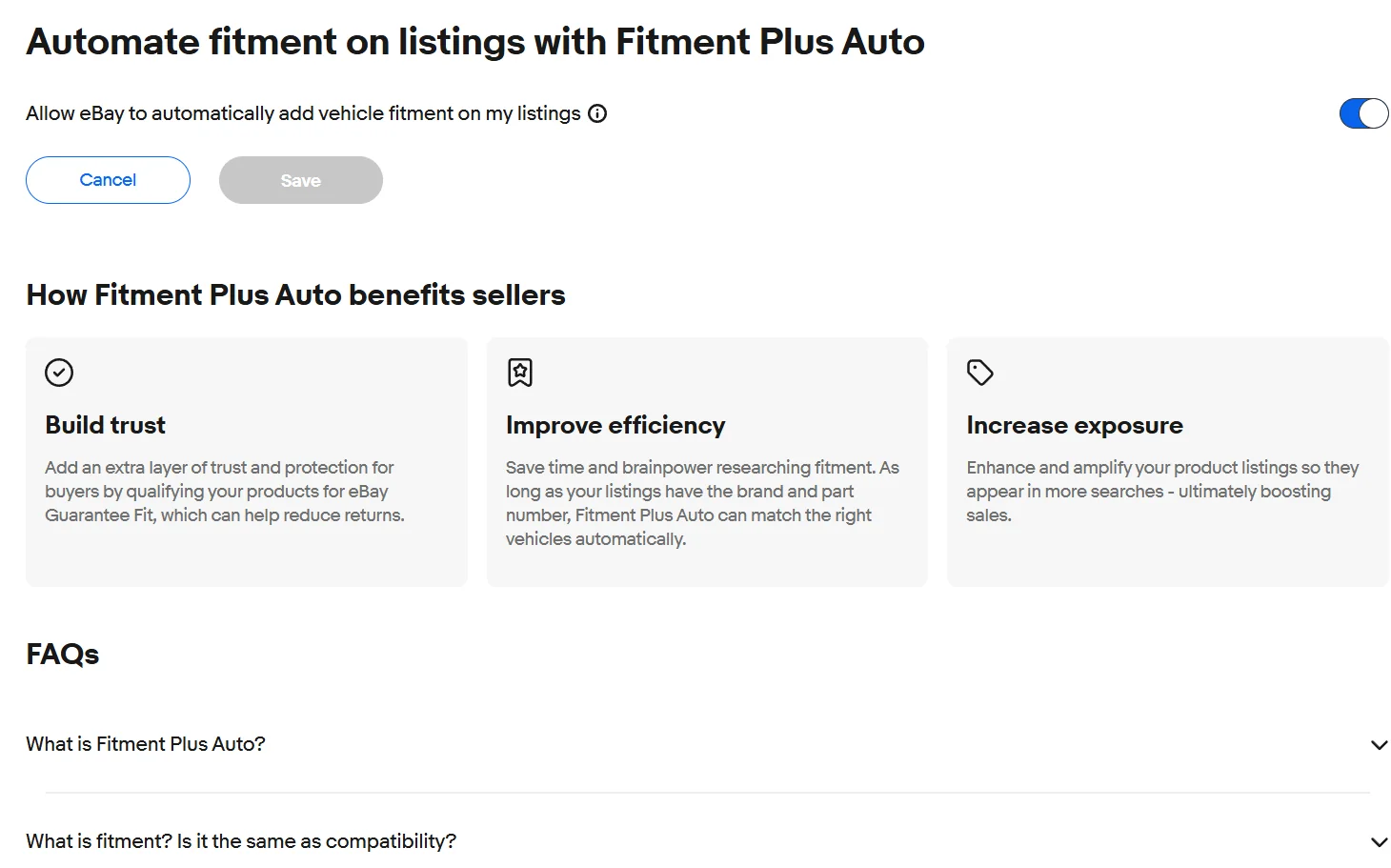
Sellers who treat fitment accuracy as a core catalog discipline, rather than something copied from a competitor’s listing, consistently see better outcomes. This is a major reason eBay for automotive parts sellers continues to outperform marketplaces without a dedicated vehicle-matching structure.
Selling Used Auto Parts on eBay: Condition Transparency Builds Trust
A large share of automotive demand on eBay involves used, reconditioned, or salvage-grade parts. The platform’s structure is built for this: condition fields, item specifics for grading, and policies around core charges and warranty disclosures give sellers a standardized way to communicate exactly what a buyer is purchasing.
Sellers can describe actual condition, photograph the individual unit, include donor-vehicle details, note cosmetic wear, specify OEM and interchange numbers, and price according to scarcity rather than a uniform catalog.
That makes selling used auto parts on eBay practical for dismantlers, recyclers, salvage yards, and specialist breakers. Engines, modules, mirrors, lights, switches, and hard-to-source OEM components can match buyers searching for an exact replacement.
eBay for Industrial Equipment Sellers: A Purpose-Built B2B Channel
Industrial sellers benefit from a parallel advantage: eBay’s Business & Industrial category, expanded over time into what the platform now positions as its business supply offering. This structure spans several subcategories, including:
- MRO and industrial supply
- Electrical and test equipment
- Manufacturing and metalworking equipment
- Heavy equipment and machinery
This gives procurement-minded buyers a dedicated section rather than a subcategory buried inside consumer listings. Facility managers, maintenance teams, and procurement professionals use this category because it combines new, used, refurbished, and long-tail inventory in one place, something few competing marketplaces replicate. eBay has also built integrations that let procurement platforms compare negotiated supplier pricing against eBay seller pricing, routing qualified B2B demand directly toward sellers.
Since competition in many industrial subcategories remains lower than in consumer categories, sell-through rates for well-listed components, safety equipment, and machinery parts tend to stay strong.
How Does eBay Help Sellers Manage Large Parts Inventories?
Parts and industrial catalogs frequently run into the thousands of SKUs, and eBay has built tooling specifically for that scale:
| Tool | What it handles |
|---|---|
| Seller Hub | Creating listings (through CSV and XLS uploads) and revising price, quantity, and item specifics in bulk |
| Motors Parts Sales Hub | Uploading and managing fitment using downloadable master vehicle lists |
| Bulk Listing Tool | Bulk listing revisions, relists, and drafts across up to 2,000 listings in one session |
| Inventory sync (native or third-party) | Preventing overselling across multiple sales channels |
| Merchant Integration Platform | Feed-based uploads for high SKU counts and returning order data to your own system |
Beyond native tools, sellers managing large inventories typically add structured SKU labeling that ties every listing back to a single source-of-truth catalog. Relying on an outdated spreadsheet as the fitment or inventory reference erodes accuracy over time, as staff quietly patch listings around the file’s errors rather than fixing the source.
A centralized, regularly audited catalog paired with eBay’s native bulk tools lets sellers scale from hundreds to thousands of active listings without a proportional increase in manual work.
Key Takeaway for Sellers Considering Selling Industrial and Automotive Parts on eBay
For industrial and automotive parts sellers, the platform’s advantages are structural. However, none of these structural advantages perform on their own. Fitment accuracy, category compliance, listing optimization, and performance metrics all require ongoing attention as catalogs grow and eBay’s policies evolve. Sellers typically address this either by building a dedicated in-house team or by working with eBay account management services, depending on catalog size and internal bandwidth.
Sellers who actively manage account health, defect rates, and listing quality alongside catalog growth convert eBay’s built-in advantages into sustained, compounding sales rather than a one-time listing push. By combining infrastructure with disciplined catalog and eBay account management, sellers can position themselves to keep winning shares in a category eBay has spent years building specifically for them.
